PROJECT CONTEXT
The project involved pile foundation design in soil conditions characterized by significant spatial variability:
- Location: Europe (confidential project).
- A bored reinforced concrete pile was analyzed.
→ Cone Penetration Testing (CPT) data was used as the primary source for evaluating soil parameters. Design was initially performed in accordance with Eurocode 7 (EN 1997-1), using deterministic characteristic values. Verification was against Static Load Test (SLT) results.
ENGINEERING CHALLENGE
In standard design:
- variability is simplified into characteristic values,
- uncertainty is absorbed through safety factors.
However, this approach often leads to:
- overdesign (higher costs),
- or hidden risks (if variability is not well represented).
→ The key issue was: How to account for variability in soil parameters without excessive conservatism.
LIMITATIONS OF THE STANDARD APPROACH
The deterministic design framework:
- reduces complex soil behavior to single representative values,
- does not explicitly model variability,
- cannot quantify probability of failure.
→ As a result, design decisions are not directly linked to risk levels. This is a critical limitation for high-value or sensitive projects.
ADVANCED METHODOLOGY – PROBABILISTIC ANALYSIS
The methodology included:
- statistical characterization of soil parameters from CPT data,
- modeling of parameter variability,
- probabilistic evaluation of pile bearing capacity.
Instead of using a single CPT profile, the analysis incorporated variability:
- 20 simulated CPT tests generated from the real CPT data
- coefficient of variation considered: 5%, 10%, 20%, 30%.
This allowed:
- simulation of a range of possible outcomes,
- estimation of reliability levels,
- direct assessment of uncertainty.
→ To overcome deterministic limitations, a probabilistic approach was introduced based on CPT-derived parameters.
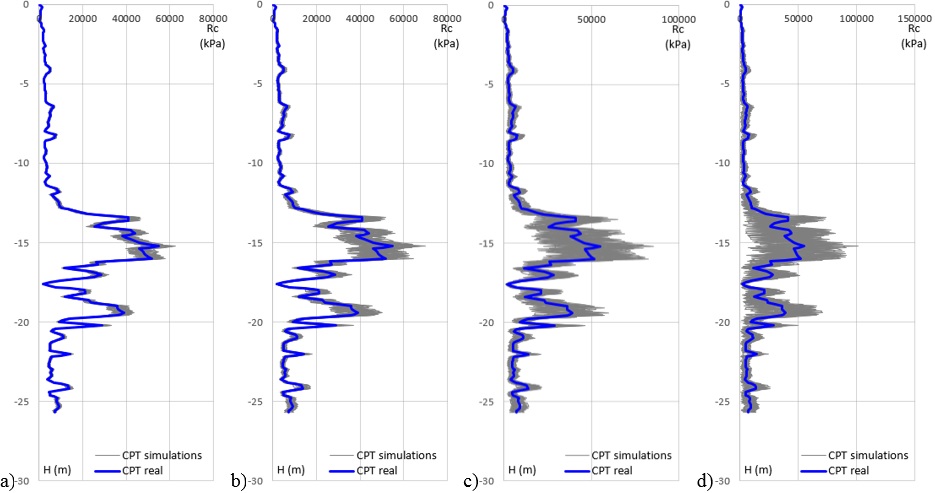
Charts of the original CPT test and generated CPT tests: a) Cv = 5%, b) Cv = 10%, c) Cv = 20%, d) Cv = 30%
KEY ENGINEERING INSIGHT
The analysis showed that:
- variability in CPT parameters significantly affects predicted capacity,
- deterministic values may not represent actual behavior,
- reliability can be quantified rather than assumed.
→ Pile capacity is not a single value — it is a distribution.
RESULTS AND PRACTICAL IMPACT
The probabilistic approach enabled:
- more realistic assessment of pile performance,
- explicit understanding of risk levels,
- improved alignment between design and actual ground conditions.
Practical outcomes:
- potential optimization of design (reduced conservatism),
- better-informed engineering decisions,
- increased confidence in foundation reliability,
- optimization of design approach – DA2 identified as most realistic.
→ Design moved from assumption-based to risk-informed.
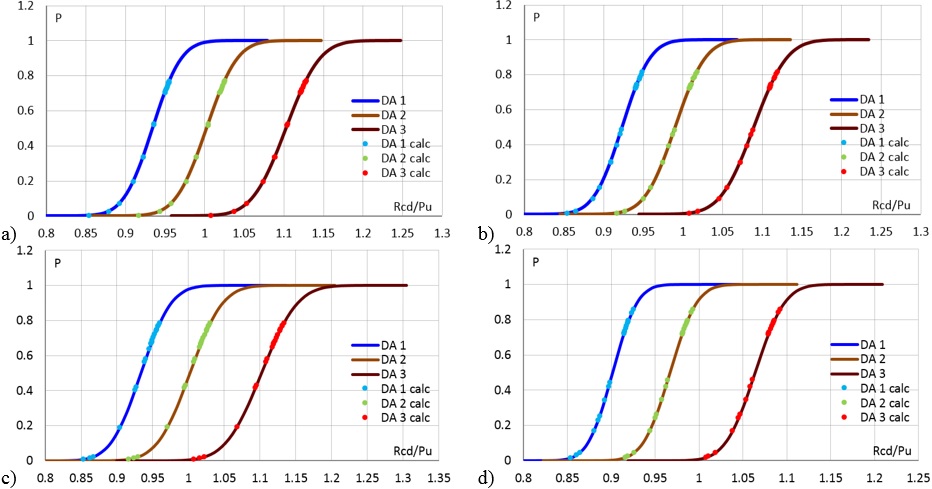
Cumulative distribution function of the normal distribution F[Rc,d/Pu|(Rc,d/Pu)mean,σR] and discrete values of normalized pile capacity
F[Rc,d,sim/Pu|(Rc,d/Pu)mean,σR]: a) Cv = 5%, b) Cv = 10%, c) Cv = 20%, d) Cv = 30%
STRATEGIC CONCLUSION
This case demonstrates that:
- integrating CPT data with probabilistic analysis,
- provides a more accurate and transparent basis for decision-making.
→ Modern pile design requires understanding variability, not ignoring it.
Cosic M., Susic N., Folic R., Bancila R.: Probabilistic Analysis of Bearing Capacity of Piles with Variable Parameters in CPT Test and Calculation According to the Requirements of Eurocode 7 (EN 1997-1: 2004) Regulations, Structural Integrity and Life, Vol. 16, No. 1, 2016. pp. 25-34.