PROJECT CONTEXT
This study focused on the reliability of Pile Integrity Testing (PIT) for assessing the structural integrity of cast-in-place concrete piles.
→ The objective was to evaluate how different types of defects influence the measured signal and whether PIT alone can provide a reliable assessment.
ENGINEERING CHALLENGE
The key challenge was the uncertainty in interpreting PIT results when defects are present.
In practice, this creates two critical risks:
- defective piles being classified as acceptable,
- sound piles being rejected due to misleading signals.
→ Both scenarios have direct financial and safety implications.
LIMITATIONS OF THE STANDARD APPROACH
The standard PIT procedure relies on:
- wave reflection analysis,
- visual interpretation of signal anomalies.
However, the method has inherent limitations:
- signal response depends on multiple interacting factors:
- defect geometry,
- depth of the defect,
- impedance contrast.
→ As a result, different defects can produce very similar signals.
ADVANCED METHODOLOGY – NUMERICAL SIMULATION
To better understand these limitations, a Finite Element Method (FEM)-based numerical simulation was performed. The analysis included:
- multiple defect scenarios (necking, inclusions, cross-section changes),
- variation in defect size and depth,
- simulation of wave propagation and reflections along the pile,
- Hilber–Hughes–Taylor numerical integration method.
→ This approach enabled controlled evaluation of cause–effect relationships between defects and signal response.
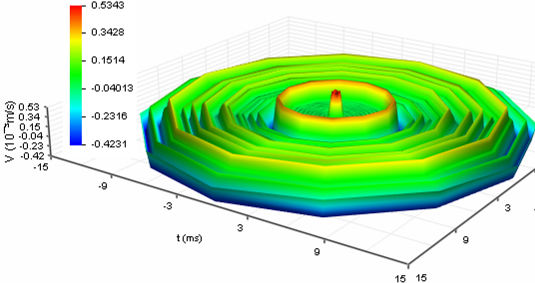
Reflectogram surface – Asymmetric reduction of the cross-sectional area at two locations along the pile.
KEY ENGINEERING INSIGHT
The simulation demonstrated that:
- similar signals can originate from fundamentally different defects,
- certain defects may produce weak or undetectable reflections,
- signal interpretation without additional analysis can be misleading.
→ There is no unique relationship between a defect and the resulting PIT signal.
RESULTS AND PRACTICAL IMPACT
Key outcomes:
- improved reliability in interpreting field test results,
- identification of scenarios where PIT alone is insufficient,
- better decision-making regarding the need for additional testing methods (e.g., CSL, PDA).
Practical impact:
- reduced risk of incorrect acceptance or rejection of piles,
- more efficient quality control strategy,
- increased confidence in foundation performance.
→ The study provided a more realistic understanding of PIT capabilities and limitations.
STRATEGIC CONCLUSION
This case study highlights that:
- advanced analysis, such as numerical simulation,
- is essential for bridging the gap between measured signals and actual pile condition.
→ PIT is not a standalone decision tool — it is an interpretation-dependent method.
Cosic M., Folic B., Folic R.: Numerical Simulation of the Pile Integrity Test on Defected Piles, Acta Geotechnica Slovenica, Vol. 11, No. 2, 2014. pp. 5-19.