In-house software
In addition to widely used engineering tools, we have developed our own specialized software solutions with intuitive GUI interfaces. These include Nonlin Quake, Simul-DLT, and R-DLT, designed to support advanced analyses in geotechnical and structural engineering.
Simul-DLT
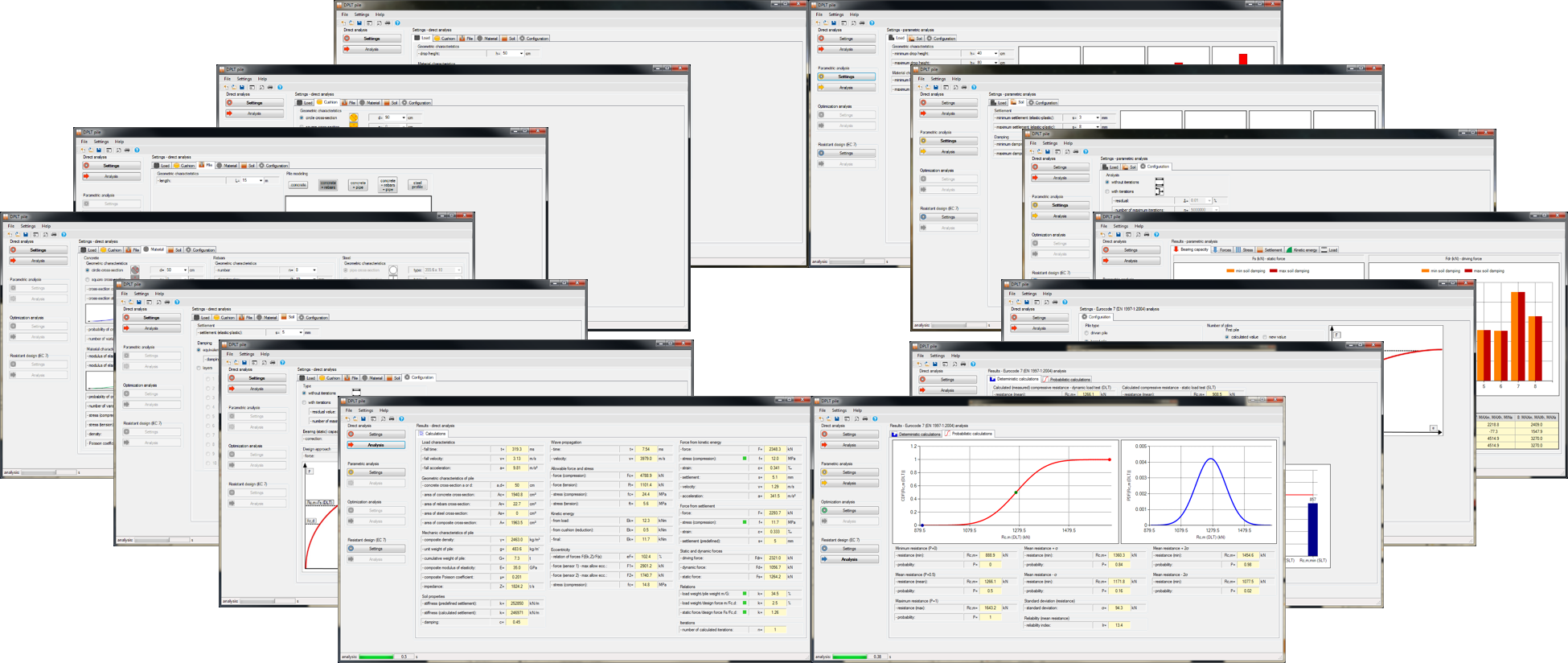
Simul-DLT is a specialized software designed for the preliminary analysis of initial parameters, parametric studies, and optimization of key variables in the Dynamic Load Test (DLT) of piles. The calculations are based on the principles of rigid body motion, deformable body mechanics, structural dynamics, wave propagation theory, and foundation engineering.
Within the software, users can perform preliminary parameter estimation, parametric analysis, optimization of critical test inputs, and design checks in compliance with Eurocode 7.
R-DLT
R-DLT is a specialized software designed for managing and processing data from Dynamic Load Tests (DLT) on piles. Its primary goal is to systematize data collection and verify pile bearing capacity according to ASTM D4945 and Eurocode 7 standards, using advanced mathematical and engineering methods.
The software enables engineers and geotechnical companies to input, organize, and analyze up to 500 types of test-related data through structured sections. It integrates data from commercial PDA/DLT systems, and geodetic monitoring. R-DLT offers interfaces for data input, a comprehensive database, cost analysis, and step-by-step monitoring of test procedures.
Customized reports can be generated, where parameters are flexibly selected or omitted depending on project requirements. With its modular sections—from soil and construction data to capacity verification and conclusions—R-DLT provides a complete, user-friendly solution for DLT management, ensuring accuracy, compliance, and transparency across all stages of pile testing

Nonlin Quake
Nonlin Quake is an advanced software system composed of several independent yet fully compatible modules, developed to perform comprehensive earthquake engineering analyses. It enables:
- creation of databases of bi-directional accelerograms,
- generation and processing of multi-component accelerograms,
- development of artificial non-stationary accelerograms (partial and complete),
- deterministic and probabilistic seismic hazard analysis,
- generation and processing of multi-component response spectra,
- evaluation of structural design parameters,
- processing of pushover curves and surfaces,
- advanced calculations using a hybrid incremental nonlinear static–dynamic analysis,
- target displacement analysis,
- scaling procedures for accelerograms and spectra,
- envelope analysis of target displacements.
The software implements four modern performance-based analysis methodologies:
- Nonlinear Static Pushover Analysis (NSPA),
- Incremental Nonlinear Dynamic Analysis (INDA),
- Incremental Dynamic Analysis (IDA),
- Hybrid Incremental Nonlinear Static–Dynamic Analysis (HINSDA).
At its core, Nonlin Quake applies the principles of Performance-Based Earthquake Engineering (PBEE), providing engineers with robust tools to evaluate seismic performance of structures across different limit states.
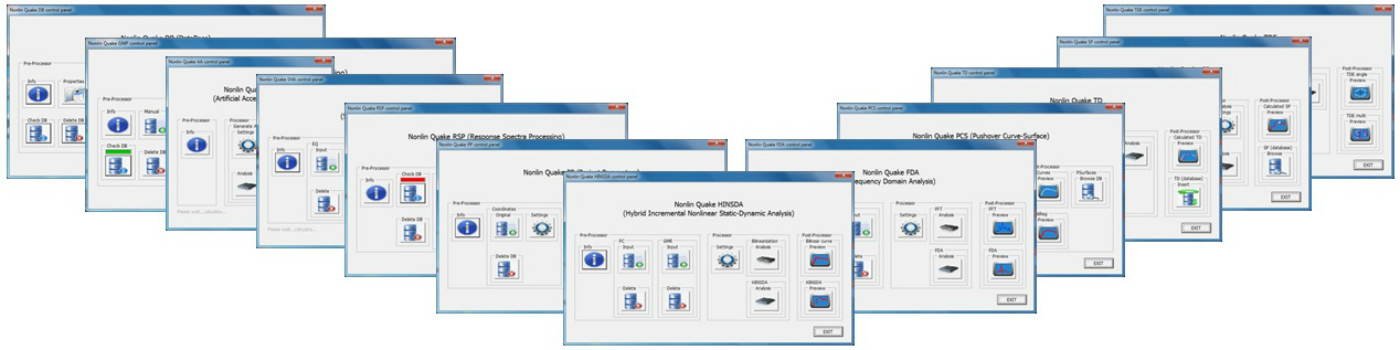
Developed in VB/VBA, the system integrates a large number of GUI-driven forms and options to streamline user interaction. The modular architecture includes:
- Nonlin Quake DB (DataBase),
- Nonlin Quake GMP (Ground Motion Processing),
- Nonlin Quake AA (Artificial Accelerogram),
- Nonlin Quake SHA (Seismic Hazard Analysis),
- Nonlin Quake RSP (Response Spectra Processing),
- Nonlin Quake PP (Project Parameters),
- Nonlin Quake PCS (Pushover Curve-Surface),
- Nonlin Quake HINSDA (Hybrid Incremental Nonlinear Static-Dynamic Analysis),
- Nonlin Quake TD (Target Displacement),
- Nonlin Quake SP (Scaling Procedure),
- Nonlin Quake TDE (Target Displacement Envelope).
With this system, engineers gain a complete analytical environment for seismic hazard assessment, structural performance evaluation, and optimization of earthquake-resistant design strategies.
We also create customized calculation algorithms tailored to specific project needs, ensuring accurate, efficient, and user-friendly solutions. Our development is based on VB.NET, VBA, and Python, allowing seamless integration into practical engineering workflows.